





Automatic Knife Release Form
You must read and fill out this form before Kai USA, Ltd. can sell to you, or ship to you, any Automatic or Butterfly Knives. By electronically signing this online form, you confirm that you are in compliance with the federal statutes shown below as well as any applicable state and local regulation.
By placing an order or receiving a product service (such as warranty repair service) from us, you agree that you meet any or all of the following criteria:
APPLICABLE FEDERAL STATUTES
18 U.S.C. § 1716 (G) (2) (1-4) provides, in summary:
Switchblade (automatic) knives can be shipped to civilian and armed forces supply or procurement officers and employees of the federal government ordering or procuring or purchasing such knives in connection with activities of the Federal government; to supply or procurement officers in the National Guard, the Air National Guard or militia of the state or territory of the District of Columbia ordering, procuring or purchasing such knives in connections with the activities of such organizations; to supply or procurement officers or employees of the municipal government of the District of Columbia or the government of any state or territory of any county, city or other political subdivision of a state or territory ordering, procuring or purchasing such knives in connection with the activities of such government.
15 U.S.C. § 1244 provides, in summary:
Knives can be shipped by common carrier; that sale, transportation or distribution, possession or introduction into interstate commerce of switchblade knives is authorized if it is pursuant to a contract with the armed forces; or, any member or employee thereof acting in the performance of his or her duty may possess switchblade knives and may have them shipped to him and sold to him or her. The possession and transportation upon his or her person of a switchblade knife or a blade 3 inches or less is authorized to any handicapped individual who has the use of only one arm.
STATE LAW PROVISIONS
It would be impossible to provide an exhaustive review of the laws that may apply in the various fifty states and in the various counties, parishes, municipalities, and other political subdivisions within each state. By signing this form below, you will be certifying that in addition to complying with federal law, you have determined which, if any, state or local laws apply to you, and that you are acting in compliance with those laws.
No Post Office Box addresses can be used on this form. Item(s) must be sent in going UPS or Fed Ex. No USPS shipments will be accepted. If the address that you have filled out on this form is no longer a valid address, you must contact us and fill out a new form.

f-18 form successfully submitted
A confirmation will be sent to your email shortly. You can find your signed form in your Account.

Please note, you cannot add to cart without signing the f-18 agreement


- 1800 SW Teton Avenue
- Tualatin, OR 97062
- Phone: 503-682-1966
- Toll Free: 800-325-2891
- Fax: 503-682-7168
- kaiusa.com
Knife Anatomy
What's the name of that part? The one between that piece and the other thing?
Know the parts of a knife, from the tip to the butt with this quick guide.
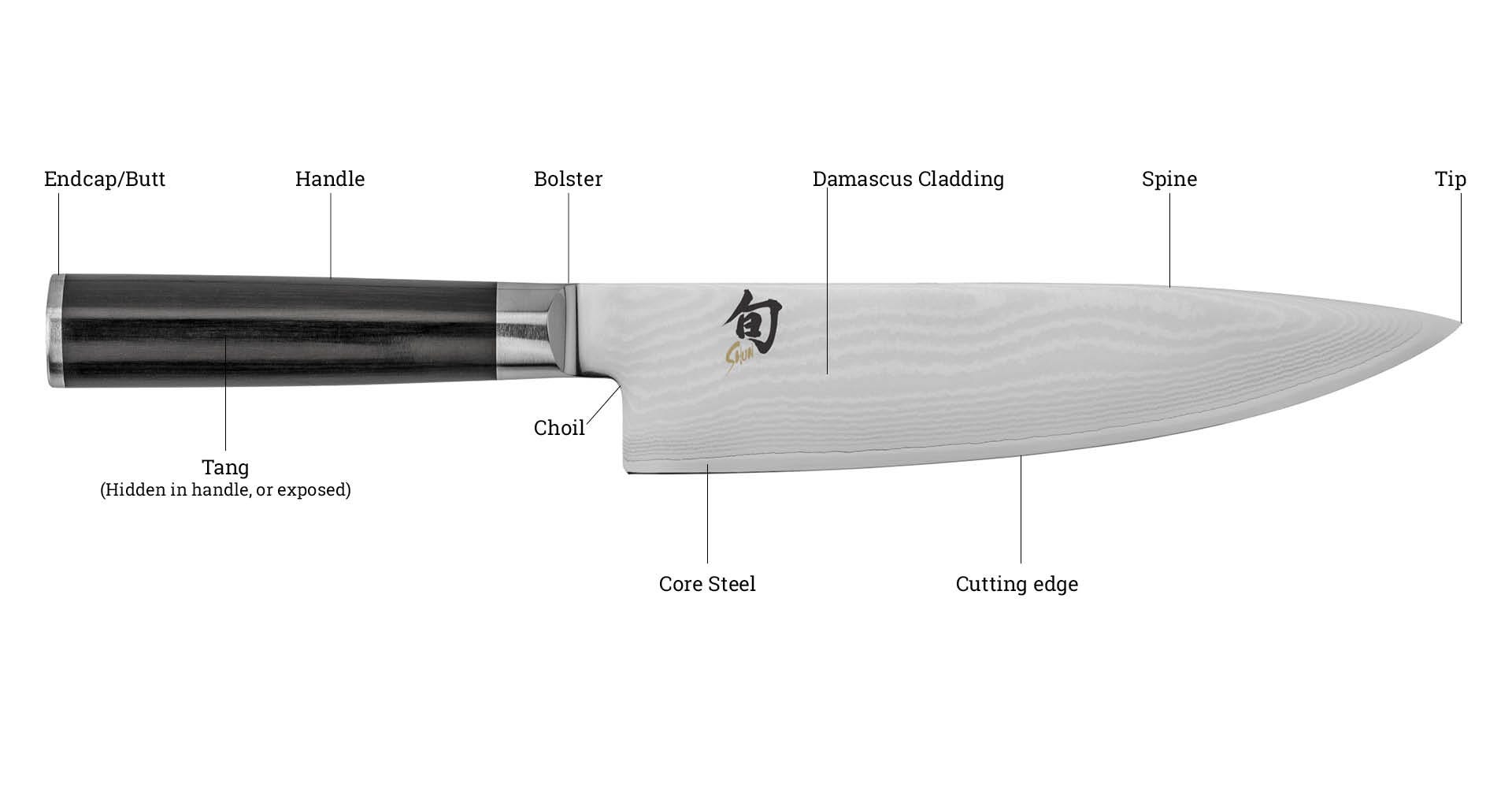
Knife Anatomy Definitions
Endcap/Butt: The end of the handle, furthest from the tip. Sometimes includes a stainless steel endcap.
Handle: The area you hold with your hand when using the knife.
Bolster: The area of the handle nearest the blade. On some knives this tapers down towards the blade to allow for a pinch grip.
Damascus Cladding: Layered steel to help protect the cutting core. Sometimes a textured finish is added to further aid food release.
Spine: The top of the knife blade, opposite the cutting edge.
Tip: The very point of the blade, furthest from the handle.
Cutting Edge: The sharpened portion of the blade used for slicing.
Core Steel: Steel in the center of the blade that is protected by Damascus cladding. This is the part of the blade that is sharpened for slicing.
Choil: The area of the blade where the tang leaves the handle and curves toward the cutting edge to allow for a comfortable pinch grip.
Tang: The area of the blade that is received by the handle. Sometimes the tang is visible between two handle scales, other times it is completely hidden.
Rivet/Fastener: Used to secure the handle to the tang. Not all Shun knife handles are secured this way.
Knife Anatomy
What's the name of that part? The one between that piece and the other thing?
Know the parts of a knife, from the tip to the butt with this quick guide.
